
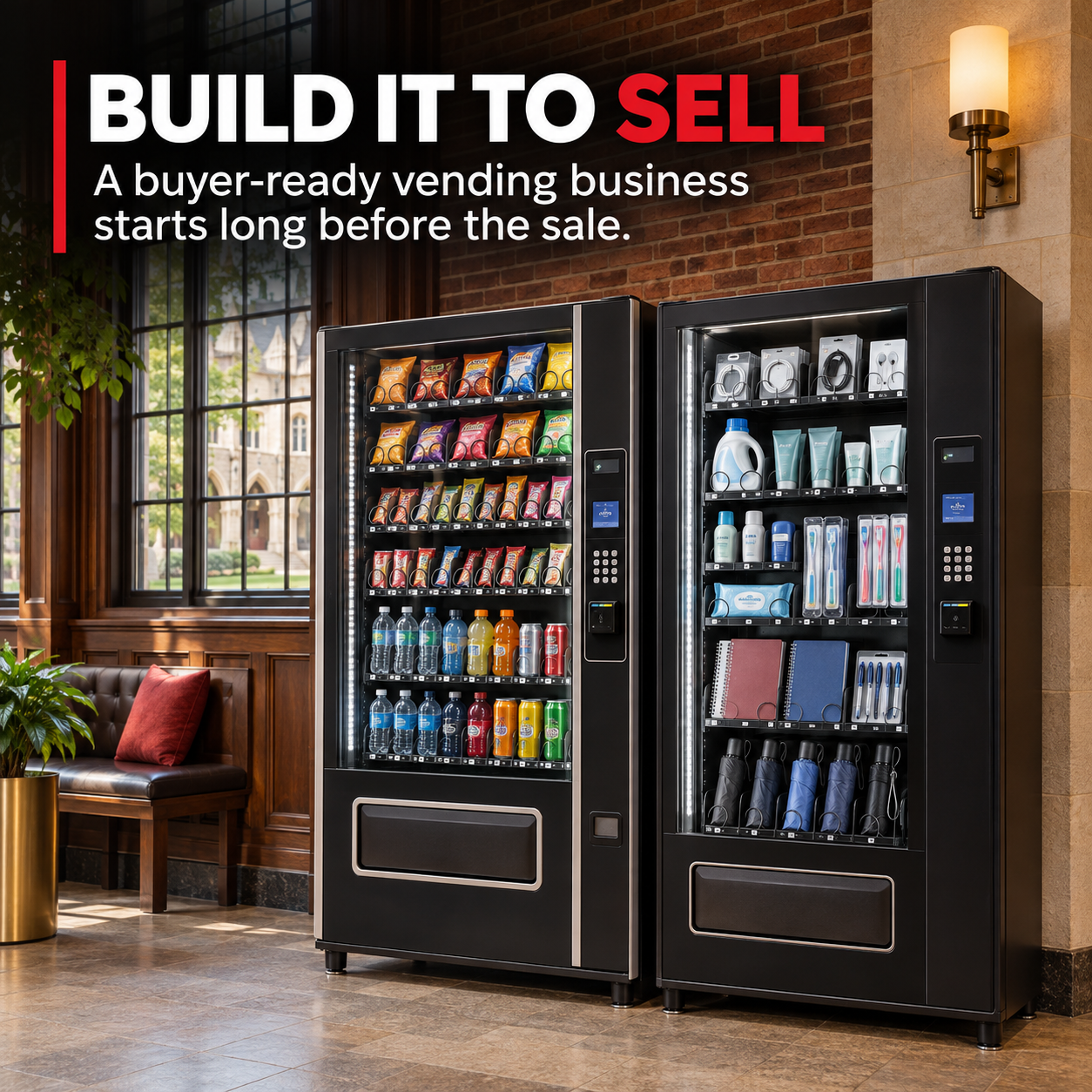
A vending business can start with one machine and grow into a valuable route. If selling someday is part of your plan, the most important work starts long before you call a broker or put the business on the market.
A buyer wants to know what the business earns, how reliable those earnings are, and whether they can continue after you hand over the keys. That means the decisions you make while building the route—where you place machines, how you document agreements, what you track, and how much the business depends on you—can shape the quality of your eventual exit.
There’s no guaranteed formula for selling at a massive profit. Business value depends on the earnings, assets, risks, local market, and deal terms. Still, you can build a vending operation that is easier to understand, easier to transfer, and more appealing to a qualified buyer.
Start by understanding what a buyer may pay for
Vending business owners often talk about revenue, but buyers usually pay closer attention to seller’s discretionary earnings, or SDE. SDE is a measure of the financial benefit available to one owner-operator after accounting for the owner’s compensation and certain documented, discretionary, or one-time expenses. It needs to be calculated consistently and supported by records; it isn’t a number to estimate from memory.
Recent BizBuySell data offers a useful reference point. For vending businesses sold on its platform between 2021 and 2025, the median reported sale price was $83,500, with median reported revenue of $71,000 and median owner earnings of $39,601. The median sold business traded at about 2.15 times SDE; the middle half of reported sales ranged from 1.80 to 2.62 times SDE. These figures describe reported platform transactions, not every vending business or a formal appraisal of yours.
Here’s how to read that range. If a business could support $100,000 in verified annual SDE, multiplying by 1.80 to 2.62 produces an illustrative value range of $180,000 to $262,000. At the reported median multiple of 2.15, the illustration is $215,000. That is a rough market-based example—not a promise, offer, or take-home amount. Debt, taxes, transaction costs, inventory, working capital, deal structure, and the specific risks of the business all affect what a seller receives.
The same data reports a median revenue multiple of 1.11 for sold businesses, but revenue alone can hide important differences in cost of goods, commissions, labor, repairs, and route efficiency. Two operators with similar sales can have very different earnings and very different buyer appeal. For an owner-operated route, a buyer needs to see how sales turn into sustainable cash flow.
Build a transferable route, not a job only you can do
A route can look profitable on paper and still be hard to sell if every important relationship and operating detail lives in the owner’s head. Buyers are looking for a business they can take over, learn, and keep running.
That begins with location agreements. Keep a written record of every placement, including the location’s contact, machine details, commission or rent terms, service expectations, agreement length, renewal dates, and any conditions for ending or transferring the arrangement. Don’t assume a placement will automatically carry over to a new owner; confirm what the agreement says and whether the location must approve a transfer.
Track your business by location and machine, not just as one total on a monthly spreadsheet. Record sales, product costs, commissions, payment processing fees, spoilage, service calls, and the time and mileage required to keep each account operating. Over time, that tells you which locations produce reliable earnings, which need attention, and whether the route is becoming more efficient as it grows.
Protect route density as you scale. Adding a faraway machine may increase revenue, but it can also add drive time, labor, fuel, and service complexity. A cluster of productive locations is usually easier to service and explain than scattered placements that depend on long days behind the wheel. The buyer should be able to see not only what the route earns, but what it takes to earn it.
Grow in stages and measure what each stage adds
A disciplined operator doesn’t buy equipment just to make the machine count look impressive. Before expanding, estimate the cost of the machine, delivery and setup, card reader, initial inventory, repairs, and the time required to service it. Then track what the account produces after those expenses.
As the route grows, review each location’s sales and margins against your expectations. If an account underperforms, determine whether the issue is product mix, pricing, foot traffic, machine downtime, or the placement itself. Keep those notes. They show a buyer that you understand the business drivers and have a process for improving results.
A useful monthly dashboard can include gross sales, product cost, gross profit, commissions, card fees, operating costs, owner hours, route miles, service incidents, and machine uptime. Compare results month over month and year over year. If sales increased, be ready to show what changed and whether the improvement is continuing.
The market data suggests that larger businesses and higher-volume accounts can attract higher earnings multiples, but scale alone doesn’t create value. The strongest story is growth that also produces reliable earnings and can be maintained without the seller personally doing every refill, repair, and location check-in.
Put repeatable systems in place before you need them
Document the routine work that keeps the route moving: how products are selected and ordered, how inventory is rotated, how cash and card sales are reconciled, how machines are cleaned and checked, and how service issues are reported and resolved. Keep an asset list with each machine’s model, serial number, location, condition, purchase date, and maintenance history.
If you bring on help, create clear checklists and train someone to cover the route. A buyer will want to understand what the owner does, what employees or contractors handle, and what it would cost to replace the owner’s day-to-day work. You don’t need a large staff to build a sellable business; you do need to show that operations are organized and teachable.
Pay attention to who owns the relationships. Keep location contacts and account history in a company system, and make sure communications, agreements, and service records aren’t stored only in a personal inbox or phone. If every location calls you directly and no one else knows the history, the buyer may see the route as less transferable.
Make the financials easy to follow—and easy to verify
Clean financial records are one of the clearest ways to build buyer confidence. The IRS explains that good records help a business prepare accurate financial statements, identify income sources, track deductible expenses, and support the amounts reported on tax returns. It also recommends keeping orderly supporting documents for sales, inventory, and expenses.
Use a dedicated business bank account and credit card. Keep business and personal spending separate, record transactions regularly, and reconcile the books to bank statements, card-reader reports, cash collections, product invoices, and tax filings. If you take cash from machines, record when it was collected and how it was deposited. If you use a payment platform, retain the reports that tie transactions to locations and machines.
Prepare monthly profit-and-loss statements, a balance sheet, and cash flow reports. Keep an organized general ledger and retain tax returns and supporting documents. SCORE’s guidance for owners preparing for a sale recommends getting monthly or quarterly financial statements, tax returns, and other key financial information in good order, with a CPA review of the statements.
If you want to claim an add-back—such as a one-time expense or a personal expense run through the business—keep the receipt and explain why it should be excluded from the buyer’s view of ongoing earnings. Don’t simply delete expenses to make the profit look better. A buyer and their accountant may test those adjustments against bank statements, invoices, tax returns, and the general ledger. A smaller earnings figure that is well supported can be more persuasive than a larger figure that is difficult to prove.
Show the earning potential with evidence, not just optimism
A buyer wants a credible view of what the business could earn in the future. Your best evidence is a track record: location-level sales, consistent margins, repeat purchases, reliable machine uptime, and operating costs that are understood.
Present growth opportunities separately from current performance. If a location has agreed to add another machine, document the agreement and expected timing. If you’re pursuing a new account, show its status as a prospect rather than counting it as revenue. If you believe a route can add more machines, explain the service capacity, equipment investment, and labor that expansion would require.
A simple forecast can show a conservative, expected, and growth scenario. List the assumptions behind each one: number of placements, sales per machine, product costs, commissions, service time, and capital needed. Keep actual results next to projections so a buyer can see whether the business has delivered on prior expectations. SCORE recommends maintaining financial models and projecting performance, while tracking actual results against the plan.
This is where your data becomes part of the sales story. A buyer can evaluate a specific route with a location map, machine register, account history, and operating reports far more easily than a broad claim that “there’s lots of room to grow.”
Think about the exit before you’re ready to leave
You don’t need to be planning a sale next year to make smart exit-minded decisions now. Review your business annually as if a buyer might ask to see the books and operations. What would be hard to explain? Which locations are dependent on you personally? Are there machines with incomplete service records? Can you tie reported sales to payment and bank records? Could someone else keep the route running for a month?
A few years before a sale, ask a CPA to review the financials and discuss the tax implications of different deal structures. Consider speaking with an attorney and a vending-experienced broker or business intermediary about contracts, transfer requirements, valuation methods, and the likely buyer pool. The SBA identifies income, market, and asset approaches as common valuation methods and recommends using an attorney to review the sales agreement.
Also separate the sale price from the money you’ll actually keep. A transaction may include debt payoff, closing costs, taxes, working-capital adjustments, inventory, a seller note, or payments tied to future performance. SCORE notes that deals can involve cash at closing, seller financing, or an earnout, and that the structure can affect taxes. Work with your CPA and attorney to understand the terms before you rely on a headline valuation.
Build the business a buyer can understand
The best exit strategy is a vending business that works well while you own it. Build productive routes, keep location agreements and operating records organized, track machine-level economics, and make the financials match the story. Then, when you’re ready to sell, the buyer can see what the business earns today, what it takes to operate, and which growth opportunities have real evidence behind them.
That kind of preparation can’t guarantee a particular sale price. It can make the business easier to evaluate, reduce avoidable uncertainty, and give you a stronger foundation for a serious conversation with a buyer.
Market figures in this article reflect vending business transactions reported to BizBuySell for 2021–2025, as shown in its valuation benchmarks. They are general reference data, not a formal appraisal or a guarantee of value. Actual results and sale terms vary by business, location, buyer, and market conditions.