
Finding great locations isn't usually about finding businesses that need vending. It's about finding businesses that trust you enough to say yes.
Most owners aren't spending their day thinking about vending machines. They're focused on running their business, taking care of employees, serving customers, and solving the hundred other problems on their plate. That's why every objection really comes down to one question:
"Is this going to create more work for me, or make my life easier?"
The operators who consistently land the best locations understand that. They don't rely on memorized sales scripts or high-pressure tactics. They have honest conversations, educate owners on what full-service vending really looks like, and focus on building partnerships that benefit everyone involved.
Here are some of the most common objections you'll hear—and practical ways to handle them.
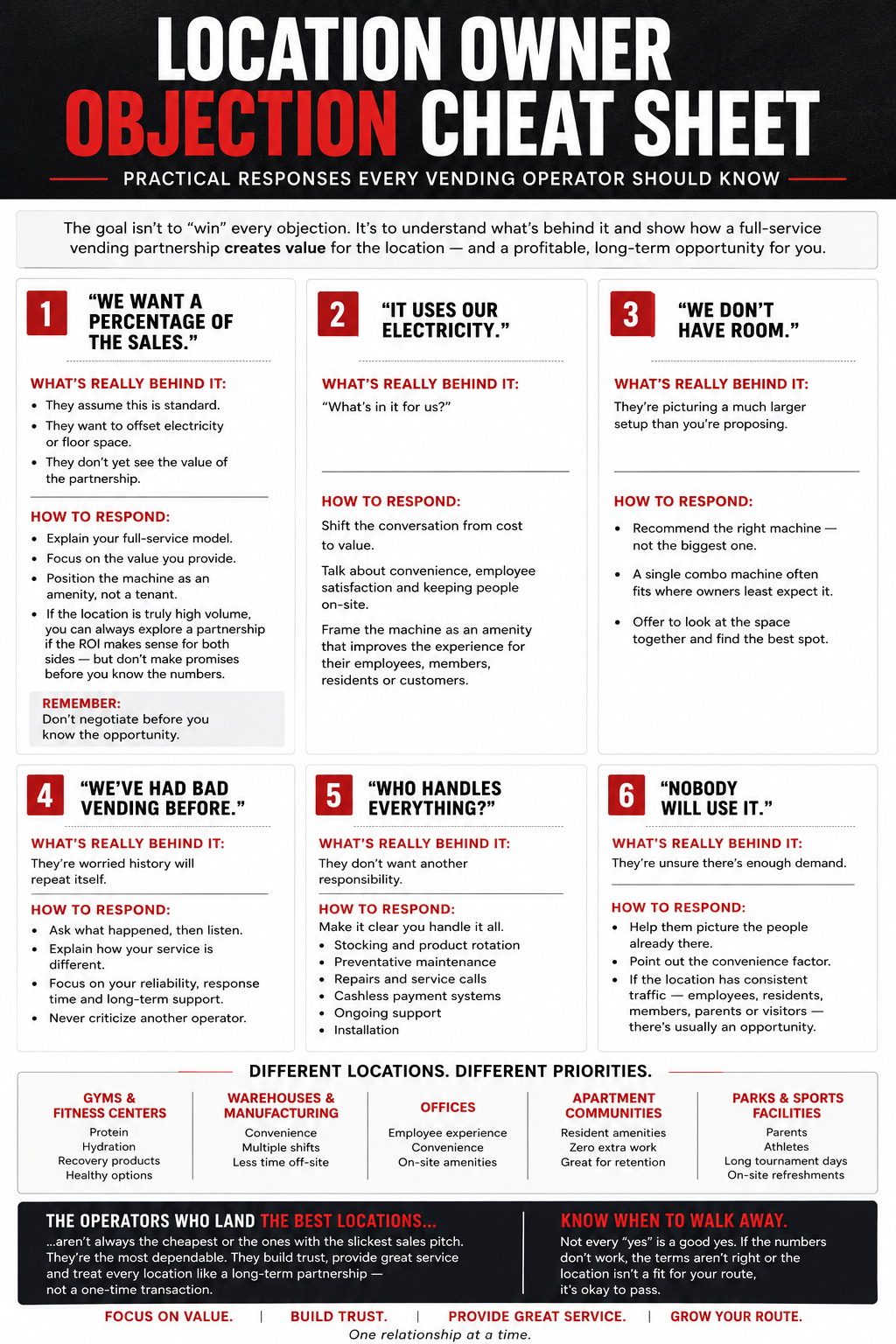
"We Want a Percentage of the Sales."
For many new operators, this is the objection that feels the hardest to overcome. It shouldn't.
Wanting a commission doesn't automatically mean the owner is being unreasonable. In many cases, they're simply trying to understand how the relationship works.
Many business owners assume that if a vending machine is using their electricity or occupying a small amount of floor space, they should receive a percentage of the sales.
It's a fair question, especially if they've never worked with a full-service vending operator before. This is your opportunity to explain your business model.
Share that your goal is to reinvest those dollars into the location by providing dependable service, keeping machines stocked, responding quickly to maintenance issues, and offering a better overall experience for the people using the machine. That's how you're able to build long-term partnerships instead of simply placing equipment and hoping for the best.
That doesn't mean revenue-sharing opportunities never exist. Every location is different, and if a location generates enough volume for both parties to benefit, there's always room to discuss a partnership that makes financial sense for everyone involved.
The important thing is to avoid making promises before you understand the opportunity. A partnership should create value for both sides—not make it harder for either side to succeed.
Many owners initially see the machine as a tenant taking up space. Your job is to help them see it as an amenity that improves the experience for employees, customers, members, or residents. That's a completely different conversation.
"We've Had Vending Before and It Was Terrible."
This is one of the best objections you can hear. Why? Because they're not saying they don't want vending. They're saying they don't want another bad vending company. There's a big difference. Instead of rushing into why you're different, ask what happened. Maybe the machine was constantly empty. Maybe service calls took forever. Maybe products were expired. Maybe it never accepted cards. Maybe nobody seemed to care once the machine was installed. Once you understand what went wrong, you can explain how your company operates differently. Don't spend time criticizing another operator. Spend time explaining your standards, your service process, and your commitment to taking care of the location long after installation day.
"It Uses Our Electricity."
This objection usually isn't about the electric bill. It's about perceived value. The owner is wondering whether they're giving something up without getting enough in return. Rather than debating what a vending machine costs to operate each month, help them think about what it provides. For an office, it gives employees convenient access to snacks and drinks without leaving the building. For a warehouse, it keeps employees on-site during breaks. For an apartment community, it's another amenity residents appreciate. For a gym, it offers members hydration and recovery products they already want. The conversation shouldn't revolve around electricity. It should revolve around how the vending program benefits the people using the facility every day.
"We Don't Have the Space."
Sometimes this objection is legitimate. Sometimes the owner is simply picturing something much larger than what you're proposing. Rather than trying to convince them they're wrong, offer to look at the space together. Many locations don't need multiple machines. A single combo machine can provide a wide variety of products while taking up surprisingly little room. Your job isn't to squeeze equipment into a building. It's to recommend the solution that makes the most sense for that location.
"Who Takes Care of Everything?"
This question often comes from owners who've had a poor experience in the past. They don't want another thing to manage. This is where full-service vending really shines. Walk them through what happens after installation. You handle inventory. You restock the machine. You perform preventative maintenance. You respond to service calls. You monitor payment systems. You take ownership of the machine so they don't have to. The less work they picture themselves doing, the more comfortable they'll feel saying yes.
"Nobody Will Use It."
Instead of arguing, help them picture the people already walking through their doors every day. Employees grabbing an afternoon drink. Parents sitting through weekend tournaments. Residents wanting a late-night snack. Gym members looking for a protein shake after a workout. People don't use vending machines because they're exciting. They use them because they're convenient. If the location already has people spending time there, there's a good chance there's an opportunity.
Different Locations Need Different Conversations
Gyms & Fitness Centers
Lead with products that fit their members. Protein shakes. Hydration drinks. Recovery beverages. Healthier snacks. Owners want amenities that align with their brand—not just another vending machine.
Warehouses & Manufacturing Facilities
Focus on convenience during every shift. Employees often have limited food options nearby, especially overnight. Keeping drinks and snacks on-site saves time and creates a better experience for the workforce.
Offices
Talk about convenience. Small amenities can have a surprisingly positive impact on employee satisfaction, especially when they're available throughout the workday.
Parks, Recreation & Sports Facilities
Parents, athletes, coaches, and spectators often spend entire days at tournaments and practices. Convenient refreshments improve the experience while reducing the need for families to leave between games.
Apartment Communities
Property managers aren't looking for another responsibility. They're looking for amenities residents appreciate without creating more work for the leasing office. That's exactly what a well-managed full-service vending program provides.
Know When to Walk Away
Every location isn't a good location. One of the biggest mistakes new operators make is trying to say "yes" to every opportunity. If the numbers don't work, it's okay to walk away. A location that demands a large revenue share but has very little foot traffic may never become profitable. A location that's an hour off your route for one small machine may cost more to service than it ever earns. Some owners expect free products, immediate service at all hours, or terms that simply don't make sense for your business. None of those are necessarily bad people or bad businesses. They may just not be the right fit. Sometimes protecting your route is just as important as growing it.
The Operators Who Build the Best Routes...
...aren't always the cheapest. They aren't the ones with the slickest brochures. And they usually aren't the ones with the perfect sales pitch. They're the operators who are dependable. They communicate well. They keep machines stocked. They solve problems quickly. They treat every location like a long-term partnership instead of a transaction. That's what owners remember. That's what leads to referrals. And that's how great vending routes are built—one relationship at a time.