
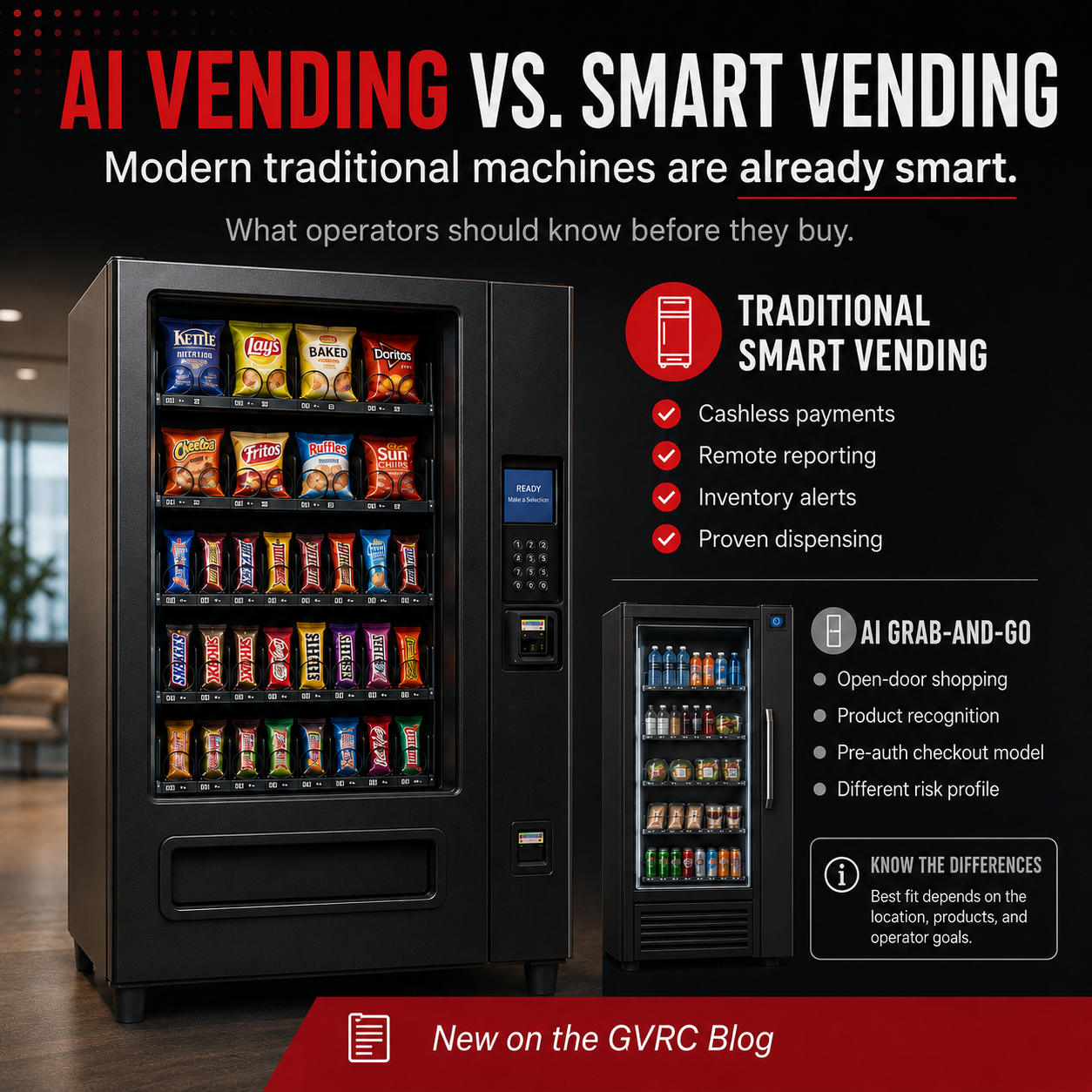
“AI vending” is having a moment.
Machines like Qingo’s AI-powered coolers promise a more modern vending experience: tap a card, open the door, grab what you want and walk away. Cameras and computer vision determine what the customer took, the transaction is completed automatically, and inventory information is sent back to the operator.
It’s impressive technology. It also raises an important question for vending operators: How different is an AI vending machine from a modern traditional vending machine that already offers cashless payments, remote inventory management and real-time sales reporting?
The answer is a little more nuanced than the marketing might suggest.
First: Modern Vending Machines Are Already Pretty Smart
When people hear “AI vending,” it can make conventional vending equipment sound outdated. That isn’t really the case. Many of today’s traditional vending machines can be paired with modern card readers, telemetry systems and vending-management software that give operators access to sales information, inventory levels, machine activity and other data remotely. That means an operator running a Jofemar Combo, Crane BevMax, Crane snack machine, AP snack machine, Royal drink machine or similar equipment may already have access to much of the operational technology people associate with “smart vending.”
Depending on the equipment and management system being used, operators can monitor sales, determine what needs to be restocked, identify trends and make better route decisions without physically opening every machine. So inventory reporting isn't necessarily what makes an AI machine different. The bigger difference is what happens on the customer side of the glass.
The Real Difference: The Machine Doesn't Vend Anything
Traditional vending follows a very controlled transaction. The customer chooses an item. The payment is authorized. The machine dispenses that specific product. Whether the machine uses a coil, belt, elevator or another delivery system, the basic process is the same: Select → Pay → Vend.
AI coolers like Qingo change that process completely. Qingo describes its system as a computer-vision-powered, grab-and-go experience. The customer presents a payment method to unlock the cabinet, opens the door, physically takes the products they want and closes the door. Cameras and AI identify what was removed, and the customer's payment method is then charged for the purchase.
In other words, it operates more like a tiny unattended convenience store than a traditional vending machine. That difference creates some very real advantages.
AI Coolers Offer Much More Merchandising Flexibility
A vending operator is normally working within the physical limitations of the dispensing system. Products have to fit. A snack needs to work with the coil or delivery mechanism. Bottles and cans need to work within the drink-machine configuration. Unusually shaped packages, fresh-food containers and fragile products can be more challenging. A grab-and-go cabinet removes much of that limitation. Because the customer physically removes the product from the shelf, Qingo says its systems can accommodate things like fresh meals, salads, sandwiches, different bottle sizes and other irregularly shaped products that aren't always ideal for mechanical vending. That opens some interesting opportunities for operators serving hotels, apartment communities, workplaces, hospitals, colleges and other locations where customers may want more than chips, candy and bottled drinks.
Customers can also pick up several items during the same shopping session instead of making individual selections.
There is another obvious advantage: No spiral means no bag of chips dangling helplessly from a coil after you've already paid for it. Anyone who has operated vending machines—or bought something from one—knows exactly what we're talking about.
Where AI Creates a Different Kind of Risk
Here's the part we think operators need to understand before getting swept up in the technology. Traditional vending keeps control of the merchandise until the transaction is approved. If someone selects a $3 drink and their payment is declined, the machine doesn't dispense the drink. With an AI cooler, the sequence is different. The payment method is authenticated first, the door opens, and then the customer gains physical access to the inventory. That creates a payment-security question operators should ask before purchasing any grab-and-go system:
What happens if the customer's card can cover the initial authorization but can't cover everything they take?
The $10 Card and the $30 Shopping Trip
Imagine an AI cooler is configured with a $10 pre-authorization. A customer taps a debit card and has at least $10 available, so the authorization succeeds and the door opens. Then the customer takes $30 worth of merchandise. The AI can perfectly identify every product they removed. That's not necessarily the problem. The question is whether the payment system can successfully secure the additional $20 before the customer walks away. The merchandise is already in the customer's hands.
This is a known issue in controlled-access retail, which is why payment systems have developed additional protections around pre-authorization.
365 Retail Markets, for example, explains that pre-authorization is used specifically to limit an operator's financial exposure. When a purchase exceeds the amount initially authorized, its system can attempt an incremental authorization for the additional amount—although handling can depend on the card issuer and payment type.
Nayax also offers incremental authorization. Instead of relying solely on one fixed authorization at the beginning of the transaction, the system can increase the authorized amount before settlement as the transaction grows. Nayax specifically notes that a standard fixed pre-authorization may not cover a larger final purchase, while incremental authorization can reduce settlement failures.
That's an important distinction.
Computer vision can tell you what left the cooler. Payment authorization determines whether you actually get paid for it. Those are two different things.
So Why Not Just Put a Big Hold on Every Card?
You could. Set the machine to require a $50 authorization before opening the door and you've created considerably more protection for the operator. You've also created another problem. Someone who wants a $2.50 bottle of water may now need $50 available on their debit card just to open the refrigerator. For customers using debit cards or accounts with lower available balances, that can lead to unnecessary declines. Customers may also see the temporary authorization sitting in their banking app and assume they've been charged $50 for a Coke. Smart-cooler providers openly deal with this tradeoff.
Some systems therefore use a relatively small initial authorization and then increase the authorization incrementally as the purchase grows. That's a much better solution when properly implemented—but it illustrates something important for operators: The payment architecture matters just as much as the AI.
Questions We'd Ask Before Buying an AI Vending Machine
If you're comparing an AI cooler with a more traditional vending machine, don't stop at the demo where someone opens the door, grabs a sandwich and walks away. That's the cool part. Ask about the boring stuff, too. How much is pre-authorized before the door opens? Does the machine support incremental authorization? What happens if the incremental authorization is declined while the door is already open? Is there a maximum purchase value per session? Can a card associated with an unpaid transaction be blocked from opening the cooler again? How are disputed transactions handled? What happens if computer vision identifies the wrong product? How are new products or packaging changes added to the recognition system? What happens if the internet connection drops? What ongoing software, cellular or cloud-management fees are required? Who provides technical support? What happens to the machine if the software provider or cloud platform eventually goes away? And, particularly important to us:
Who can fix it when something breaks?
AI Doesn't Automatically Mean Better
There are locations where we think grab-and-go AI vending could be fantastic. An employee break room with a relatively controlled customer base. A high-end apartment community. A hotel. A hospital. A corporate campus. The ability to offer fresh meals, unusual products and a larger retail-style selection could be a major advantage.
There are other environments where a traditional vending machine may still make considerably more sense. In a high-traffic public location, school, recreation facility or anywhere product security is especially important, there is something valuable about a machine physically holding the merchandise until a specific transaction has been authorized. Neither model is automatically better. They're solving the same problem in different ways.
Don't Confuse “AI” With “Connected”
This may be the biggest takeaway. Remote inventory management, cashless payment, sales reporting and machine monitoring are not exclusive to AI vending machines. Modern vending equipment can already be extremely connected. What computer-vision vending really changes is the retail transaction itself.
Traditional smart vending says: Tell me what you want. Pay for it. I'll give it to you.
Grab-and-go AI vending says:
Authenticate yourself. Open the store. Take what you want. I'll figure out what you owe.
That's a genuinely innovative experience—but it also introduces different considerations around payment authorization, product loss, connectivity, software and long-term service.
At Georgia's Vending Repair Center, we're excited about new technology. We're also big believers in understanding what you're buying beyond the buzzwords. Whether you're considering an AI cooler, a traditional vending machine or upgrading existing equipment with modern cashless and management technology, the right machine is the one that fits your products, your location, your customers and the way you want to operate your business. Have questions about vending equipment or what type of machine makes the most sense for your location? Give Georgia's Vending Repair Center a call. We're happy to help you sort through the options.