
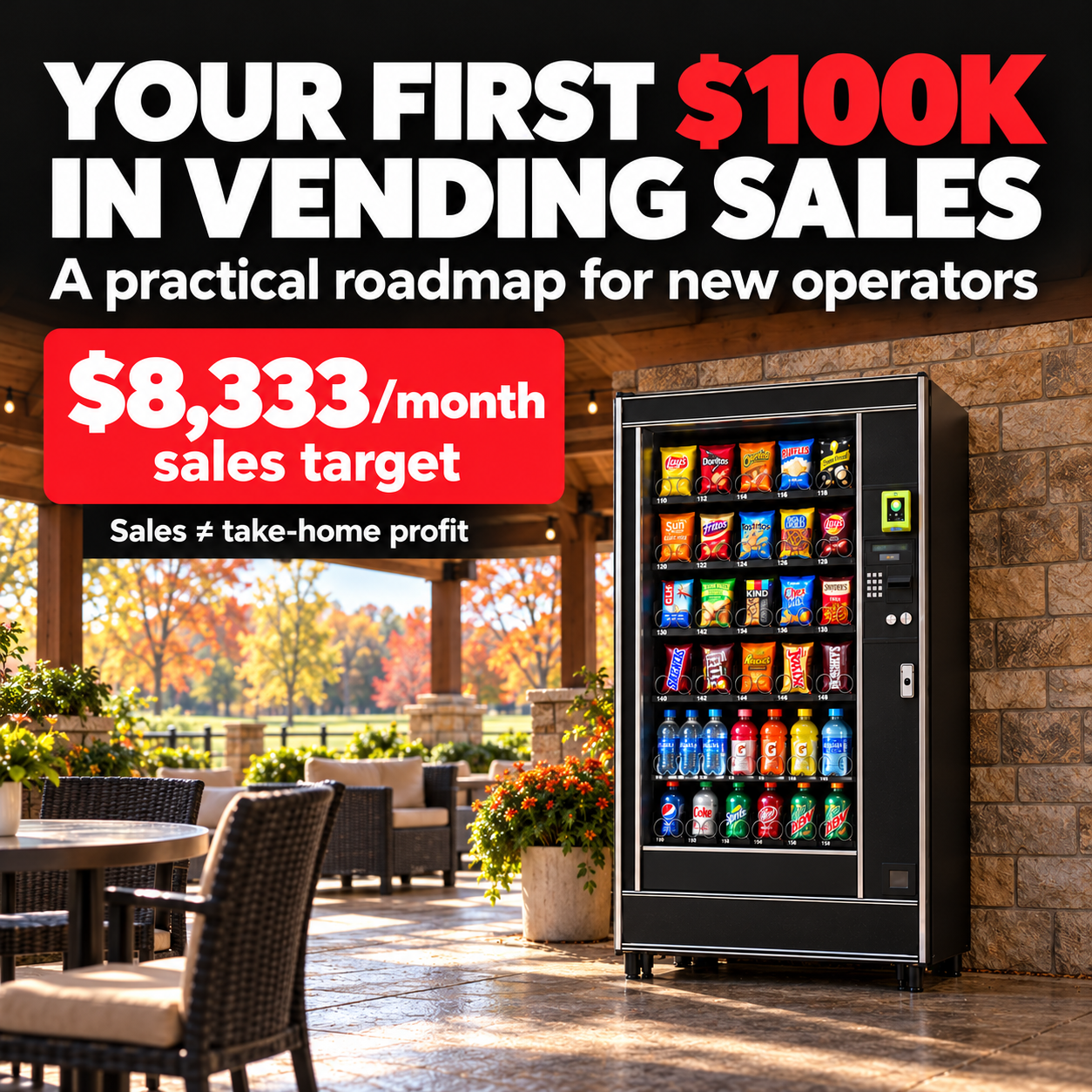
Building a vending business to $100,000 in annual sales is possible, but it usually takes more than buying a machine and finding somewhere to plug it in. The work is in choosing locations with steady demand, stocking what people will buy, and managing the route carefully enough that sales turn into profit.
First, let’s define the goal: $100,000 in annual sales is about $8,333 a month, before product costs and operating expenses. It is not $100,000 in take-home income. You still need to account for inventory, card processing, location commissions, fuel, repairs, insurance, taxes, and your own time.
Step 1: Build a sales target you can track
NAMA’s 2022–2023 industry census estimated average annual sales of $6,284 per vending machine. That works out to about $524 per month per machine, though individual results can vary widely by location, product mix, and service. At that industry average, reaching $100,000 in yearly sales would take about 16 machines. Treat that as a planning reference—not a promise about what any particular machine will earn.
You can also work backward using your own route targets. For example, ten machines averaging about $833 a month each would reach roughly $100,000 in annual sales. Six machines would need to average about $1,389 a month each. The fewer machines you operate, the more each location has to sell.
Your transaction goal matters, too. At an assumed average purchase of $3, a route needs about 33,334 sales a year, or 91 a day across all machines, to gross $100,000. If you operate ten machines, that averages around nine transactions per machine per day. That example is just planning math; your real average purchase will depend on your products and prices.
Step 2: Choose a customer and location type
Start with a specific kind of customer instead of trying to sell to every business in town. Think about workplaces, apartment communities, schools, gyms, hotels, or recreation facilities. Each has a different schedule, customer base, and product need.
Before you approach a location, do a little homework. How many people use the space each day? Are they there for a few minutes or a full shift? Are there food options nearby? Does the building have multiple shifts, regular events, or long periods when nearby stores are closed? These details can help you estimate demand and choose an appropriate machine.
The Small Business Administration recommends researching demand, market size, location, competition, and pricing before launching. For a vending operator, that means visiting the property, asking about traffic and schedules, and understanding what people can already buy nearby.
Step 3: Secure the location before buying equipment
A machine only earns when it is in a place where people want to use it. When possible, talk with potential locations before purchasing equipment. Ask what their employees, residents, guests, or customers request, where a machine could go, and who would handle access and day-to-day communication.
Before installation, put the arrangement in writing. Clarify the term of the placement, any commission, access for restocking and repairs, electrical requirements, responsibilities for damage, and how either party can end the agreement. A clear agreement helps both sides know what to expect.
Consider the route, too. Several good locations near one another may be easier and less expensive to service than machines spread across a wide area. Driving time and restocking time affect the real cost of every sale.
Step 4: Match the machine to the location
Choose equipment based on what the location needs, the products you plan to sell, available space, and your budget. A snack machine, beverage machine, or combination machine can each make sense in different settings. A refurbished machine may help keep upfront costs down, but check its condition, parts availability, payment options, and service history before you buy.
Cashless payments are worth considering. NAMA’s 2022–2023 census reported that cashless payment options can increase average spend per consumer and per machine. A card reader also gives customers another way to pay when they do not carry cash.
Budget for more than the machine itself. Include delivery and installation, initial inventory, payment equipment and fees, repairs, insurance, and a reserve for unexpected costs. The SBA recommends estimating startup costs and ongoing expenses before opening so you can set sales targets and understand your break-even point.
Step 5: Stock for the people who use the location
A good assortment starts with the customer, not a generic list of vending favorites. A gym may call for water, sports drinks, and protein snacks. A workplace with overnight shifts may need more substantial options available outside normal meal hours. An apartment community may want a mix of everyday snacks and drinks.
Ask the site contact what people request, then start with a manageable selection. Track which products sell, how quickly they move, and which ones sit too long. Use that information to adjust the assortment and order quantities. NAMA’s latest census found that 65% of surveyed operators reported client requests for healthier product mixes, so it may be worth asking locations whether better-for-you options matter to their customers.
Step 6: Price with your costs in view
The price on the machine has to cover more than the wholesale cost of the product. Calculate the item cost, payment processing, any location commission, and the portion of your route expenses that the sale needs to support. Then set a price that works for the customer and leaves enough room for the business to operate.
Review actual sales and costs regularly. A product can sell well and still contribute little if its cost or commission is too high. Track revenue and expenses by machine so you can identify which locations are carrying the route and which need a change.
Step 7: Set a service routine and measure each machine
Reliable service helps keep a location stocked and gives you the information you need to improve it. Set a regular visit schedule, check expiration dates and product condition, clean the machine, and address jams or payment problems promptly. Keep a simple record for each visit: inventory added, products sold, cash collected, issues found, and time spent.
Review machine performance monthly. Compare each location’s sales with your target, product costs, commission, and service time. If a machine is falling short, investigate before making a decision: the assortment may not fit, the machine may need repair, traffic may be lower than expected, or the location may not support vending.
Step 8: Grow in stages
A measured path might look like this:
Start with one or two locations. Learn how much inventory they need and how often they require service.
Improve the first route. Adjust products, prices, and visit frequency based on actual sales.
Add nearby locations. Build route density so additional sales do not come with unnecessary driving.
Review the numbers before expanding again. Add equipment when the location and cash flow justify it.
The vending business is part of a substantial convenience-services industry, but broad industry growth does not guarantee that a specific machine or location will succeed. NAMA’s 2024–2025 census estimates the overall U.S. convenience-services industry at $31.1 billion for 2025; that total includes vending along with micro markets, office coffee, and pantry services.
The clearest path to $100,000 is a route built around real demand, sensible equipment choices, and close attention to each machine’s numbers. Start with a location you understand, prove the model, and grow from what the sales data tells you.
If you’re comparing machines or planning your first route, Georgia’s Vending Repair Center can help you explore equipment options, card readers, delivery, and service. Reach out to talk through what may fit your location and budget.