
Your Vending Machine Isn’t Making Money. Now What?
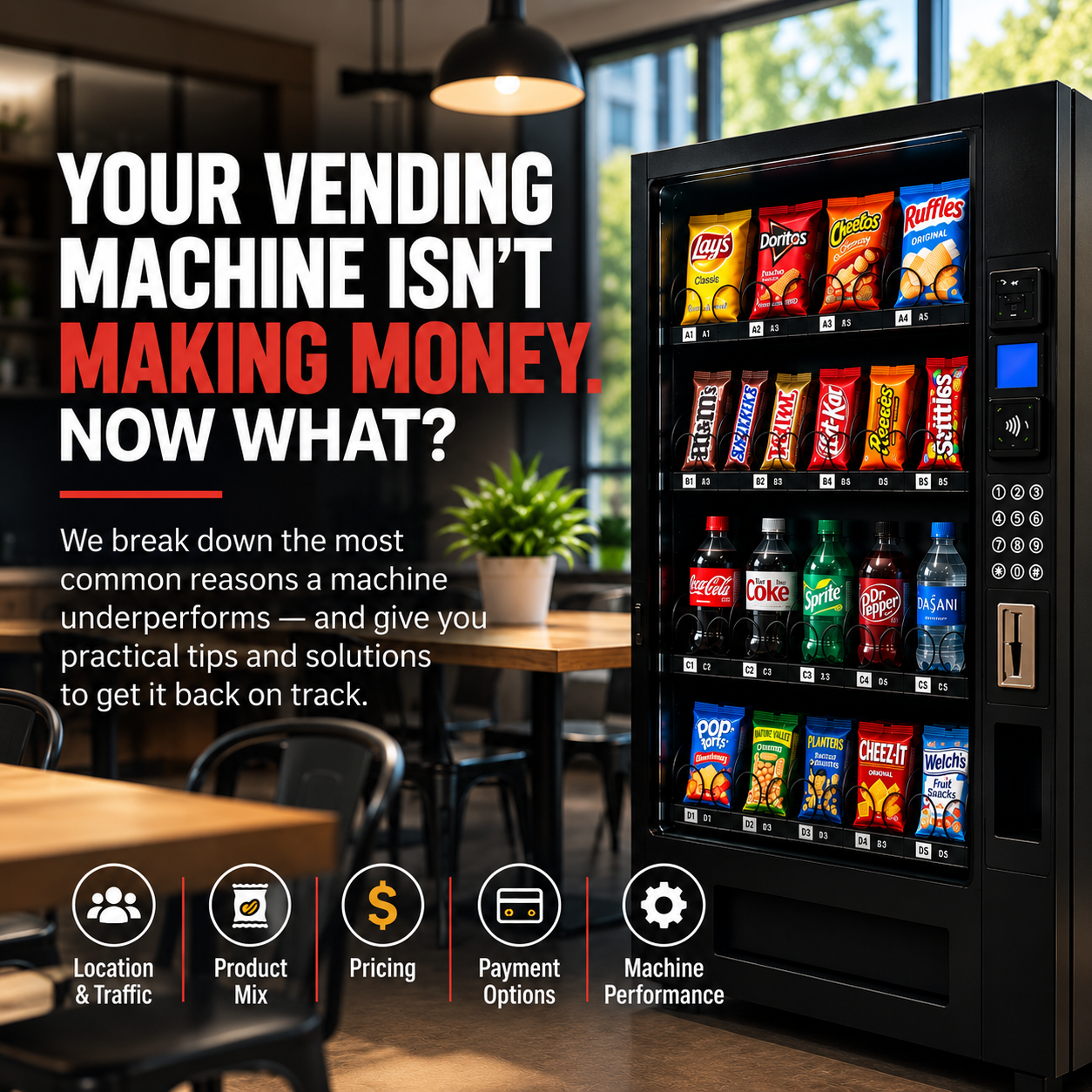
You landed the location. You bought the machine, stocked it, installed it and waited for sales to come in.
Except they didn't.
Or maybe they did at first, but over time you've found yourself looking at the numbers and wondering whether this machine is even worth servicing anymore.
An underperforming vending machine is frustrating, but pulling it out immediately can be an expensive way to solve the wrong problem. The location might be the issue. It also might be the products, prices, payment system, machine reliability or something as simple as where the machine is sitting inside the building.
Before you give up on a location, figure out what isn't working.
First: Is It Really a Location Problem?
Operators tend to talk about "good locations" and "bad locations," but foot traffic alone doesn't tell the whole story.
Start with the people who realistically have access to the machine. How many are there? How often are they there? How long do they stay? Is there another convenient place for them to buy the same things?
A warehouse with 100 employees working long shifts and few nearby food options may behave very differently from an office with 100 employees where half the staff works remotely and there's a convenience store across the street.
Look at what's changed, too. If a machine used to perform well and suddenly doesn't, the location itself may not have gone bad. Did the company reduce its workforce? Change shifts? Open an employee cafeteria? Add another vending provider? Move your machine?
That last one is easy to overlook. A machine tucked into a back hallway doesn't have the same opportunity as one employees pass several times a day.
Before blaming the machine, determine whether enough potential customers regularly see and have convenient access to it.
Next, Look at What Is Selling — Not What You Think Should Sell
If the traffic is there, turn to your product mix.
A machine can have plenty of customers and still underperform when it's stocked for the wrong ones.
Look at sales by selection if you have that data. Which products consistently sell out? Which ones are still sitting there every time you service the machine?
Those slow sellers are taking up space that could be given to products customers have already shown you they want.
This is where vending management and telemetry technology can be incredibly useful. Modern systems can provide operators with sales and inventory information remotely, allowing them to see what's moving rather than relying solely on what the machine looks like when they arrive to restock it.
The goal isn't to stock what is popular everywhere. It's to stock what is popular there.
A gym, manufacturing plant, high school, apartment complex and corporate office shouldn't necessarily have the same product mix. Even two seemingly identical offices can produce completely different buying patterns.
Give the location enough time to generate useful information, then let the customers help build the planogram.
Is the Price the Problem?
Pricing deserves a closer look, but don't immediately assume lower prices equal higher sales.
Your prices have to cover the product, card-processing costs, fuel, labor, repairs, spoilage and the cost of servicing that location. Selling more products at a price that doesn't leave enough margin isn't necessarily an improvement.
Instead, compare your pricing with the environment around the machine and pay attention to how customers respond.
If a drink is noticeably more expensive than the same drink sold 50 feet away, you may have created an easy reason to skip the machine. If there's no convenient alternative nearby, customers may place more value on the convenience.
You can also look at pricing by product instead of treating the entire machine the same way. A premium energy drink, protein shake or larger snack doesn't need to carry the same price structure as a bottle of water.
The question isn't simply, "Are my prices too high?"
It's "Do these prices make sense for these products, in this location, while still leaving enough margin to make servicing the account worthwhile?"
Can Customers Pay the Way They Want to Pay?
This one has become increasingly difficult to ignore.
Cantaloupe's 2026 Micropayment Trends Report, based on 2025 self-service transaction data, found that 78% of vending sales were cashless. The average cashless vending transaction was $2.45 compared with $1.57 for cash, and 85% of cashless vending purchases were contactless. Cantaloupe
That doesn't mean installing a card reader magically turns every poor-performing machine into a profitable one.
It does mean that a cash-only machine can create friction for customers who simply don't carry cash.
If the machine accepts cards but sales are still low, make sure the reader works consistently. The same goes for bill validators, coin mechanisms, touchscreens and keypads. A payment system that works "most of the time" can quietly cost you repeat customers.
Someone who loses money in a machine or tries twice to make a purchase and can't isn't particularly interested in diagnosing your equipment. They walk away.
Make Sure the Machine Isn't the Problem
This sounds obvious until you consider how many small problems can make a vending machine frustrating to use.
Products get hung up. Coils are set incorrectly. A validator stops accepting certain bills. The refrigeration system isn't keeping drinks cold enough. Selection buttons don't respond correctly. A card reader loses connection. The machine repeatedly shows items as unavailable.
A machine doesn't have to be completely broken to hurt sales.
Watch someone use it if you can. Is purchasing easy? Can customers clearly see the products and prices? Does the machine look clean and well maintained? Does it sound or behave like something they trust with their money?
Preventative maintenance matters here. Catching worn components, refrigeration problems, payment issues and dispensing problems before they become complete failures protects more than the equipment. It protects the customer's experience with that machine.
Check Your Service Schedule
There is another version of the "bad location" problem that operators sometimes create themselves: the machine is doing well enough to sell products, but not being serviced often enough to capitalize on it.
If the best sellers are constantly empty, customers aren't seeing a full vending machine. They're seeing a machine that doesn't have what they want.
Meanwhile, the slowest products may still be sitting there, making the machine appear stocked.
Look at what is sold out when you arrive and how long it may have been unavailable. If your top selections are empty days before your next visit, adjusting the service schedule—or carrying more of those products—may increase sales without changing anything about the location.
Talk to the People Who Use It
Your sales report can tell you what someone bought. It can't always tell you what they wanted to buy.
Ask.
If you're servicing an office, warehouse, apartment community or other managed property, talk to your contact. Have people requested anything? Are employees asking for healthier options? Energy drinks? Different sodas? Breakfast items? Larger portions?
A five-minute conversation can sometimes explain a sales report better than an hour staring at numbers.
Just don't turn every individual request into a new selection. Look for patterns.
Change One Thing at a Time
This may be the most important part of troubleshooting an underperforming machine.
If you change the products, lower all the prices, install a card reader and move the machine to another floor in the same week, you may see sales improve—but you won't know why.
Make deliberate changes and track the results.
Replace obvious slow sellers. Give customers easier ways to pay. Adjust the service schedule. Test a better position inside the location. Address mechanical problems. Then look at what happened.
You're trying to learn what makes this particular location work.
Know When It Really Is Time to Move the Machine
Sometimes you can do everything correctly and the location still doesn't produce enough revenue to justify the time and expense required to service it.
That's useful information, too.
Every stop on a route has a cost. You're spending time driving there, stocking the machine, maintaining it, processing transactions and tying up equipment that could potentially earn more somewhere else.
If you've confirmed the machine works properly, optimized the products, made purchasing convenient and given the location a reasonable opportunity to perform, the numbers may tell you it's time to move on.
That's different from giving up on a machine simply because sales were disappointing.
You've diagnosed it.
Don't Guess. Diagnose.
When a vending machine isn't making money, start by asking six questions:
Do enough people see and use the machine? Are we selling the right products? Does the pricing work for the customer and the operator? Is it easy to pay? Is the equipment working properly? Are we servicing it at the right frequency?
Work through those questions before you start hauling equipment out the door.
Sometimes the solution is a different location. Sometimes it's five new selections and a card reader.
Knowing the difference can save you a lot of money.
Need Help Getting an Underperforming Machine Back on Track?
Georgia's Vending Repair Center works with vending operators throughout greater Atlanta and North Georgia on repairs, preventative maintenance, card readers, installations, refurbished equipment and machine service.
If you're not sure whether the problem is the machine—or whether an older machine is worth continuing to invest in—we can help you evaluate the equipment and your options.