
Old Machine, New Life: When Is a Vending Machine Worth Refurbishing?
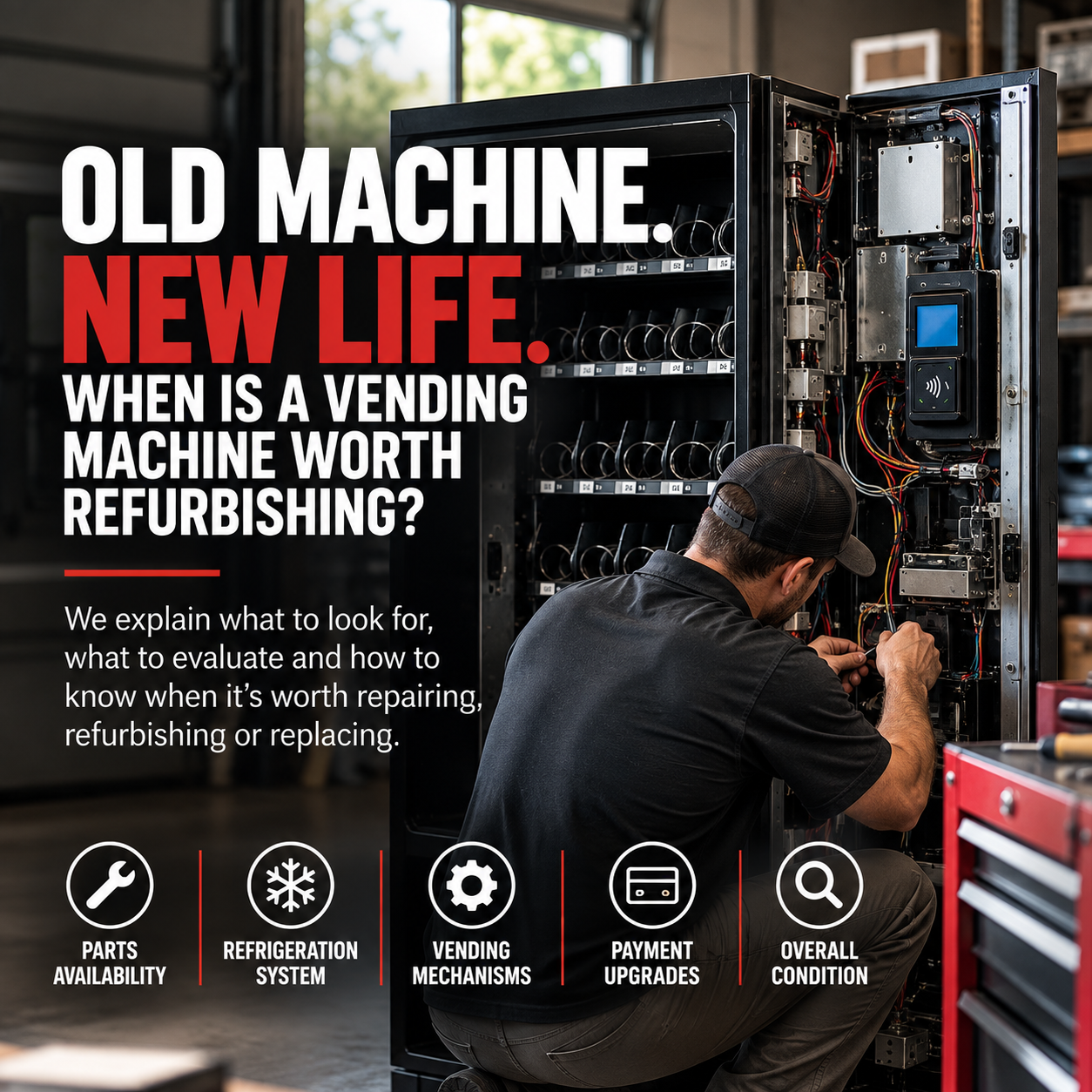
There's something satisfying about bringing an old vending machine back to life.
Sometimes it's a genuinely vintage machine someone wants restored because of its history or appearance. More often in our shop, the question is much more practical:
"I've got this older machine. Is it worth fixing?"
That's a different question—and the answer depends on a lot more than its age.
A well-built commercial vending machine can have plenty of useful life left even when it looks rough. On the other hand, an older machine that seems like a bargain can become an expensive project when critical parts are unavailable or major systems need to be replaced.
Before deciding to refurbish, repair or retire an older machine, here's what we look at.
Start With the Machine, Not Its Birthday
Age matters, but the model and condition matter more.
Two machines manufactured around the same time can be in completely different shape. One may have spent years indoors at a low-volume office and received regular maintenance. Another may have operated in a demanding environment, been moved repeatedly and accumulated years of improvised repairs.
That's why "How old is it?" shouldn't be the only question.
We want to know what it is, what condition it's in and whether the systems inside it can still be reasonably supported.
Parts Availability Can Make or Break the Decision
This is one of the first things operators should investigate with an older machine.
Manufacturers eventually discontinue models, and parts support doesn't last forever.
Vendnet, which provides parts and technical support for several vending equipment brands, says it supports parts for models for up to seven years after a model is discontinued. Its current documentation also shows an important distinction: some machines that are out of production remain supported, while other older models are specifically designated as unsupported. In some cases, remaining parts may still be available even after formal support ends. Vendnet
That's why you shouldn't assume an old machine can't be repaired—or that it can.
Get the manufacturer and model number and find out what's still available.
A machine with accessible motors, control components, payment parts and refrigeration components is a very different refurbishment candidate from one that depends on a critical component you can no longer reasonably source.
Look at the Cabinet and Structure
Cosmetics can fool you.
A machine with faded graphics, scratched paint and an ugly front may look like a lost cause while still having a perfectly serviceable cabinet underneath. Cosmetic problems can often be addressed during refurbishment.
Structural problems deserve more attention.
Look for significant rust, water damage, damaged doors, compromised hinges, broken glass, deteriorated insulation and evidence that the cabinet isn't sealing properly.
If the foundation of the machine is solid, you have something to work with.
If you're rebuilding the foundation before you can even begin repairing the vending components, the economics can change quickly.
Refrigeration Deserves Its Own Inspection
On a refrigerated drink, food or combo machine, cooling is a major part of the equation.
A machine that isn't getting cold doesn't automatically need to be scrapped. Refrigeration systems contain serviceable components and, depending on the machine, refrigeration assemblies may be repairable or replaceable.
What matters is identifying why it isn't cooling and what it will cost to correct.
The compressor, condenser, evaporator, fans, thermostat or temperature controls, seals and airflow can all affect cooling performance. The specific design varies by machine, which is another reason the model number matters.
Don't buy an older refrigerated machine simply because someone plugs it in and says, "See? It runs."
Running and cooling properly are two different things.
Check the Vending Mechanisms
A snack machine is ultimately a mechanical system that has to dispense products reliably hundreds or thousands of times.
Inspect the motors, spirals, trays, wiring and connectors. On beverage machines, inspect the appropriate delivery mechanisms for that model.
Repeated failed vends aren't a minor annoyance. They create refunds, service calls and customers who stop trusting the machine.
Some problems are straightforward repairs. Others become more complicated when the components are obsolete or someone has modified the machine over the years using parts that don't belong there.
A proper refurbishment should address how the machine functions, not just how it looks.
Then Look at the Electronics
This is where the gap between "classic" and "commercially practical" can get wider.
Older electronic machines may have control boards, displays, harnesses and other components that are increasingly difficult to source. Compatibility also matters if you want to update the machine with modern payment equipment.
A machine doesn't need the newest technology available to continue earning money.
It does need technology that can be maintained.
Can It Handle the Way Customers Pay Today?
For a machine going back into commercial service, this deserves serious consideration.
In 2025, 78% of vending sales were cashless, according to Cantaloupe's 2026 transaction report. Cashless customers also averaged $2.45 per vending purchase compared with $1.57 for cash customers. Cantaloupe
That makes payment compatibility a meaningful part of the refurbishment decision.
Depending on the machine's electronics and interface, adding a modern card reader may be straightforward, require additional equipment, or not be economically practical at all.
Don't assume every old machine can simply have a reader bolted onto the front.
Find out what the machine supports before building the cost of a refurbishment around it.
Refurbished Should Mean More Than "Looks Better"
This distinction matters.
Painting a machine and cleaning the glass can make it look dramatically different in a photograph. That doesn't tell you anything about the condition of the equipment inside.
A commercial refurbishment should be driven by the actual condition of the machine. That may include cleaning, testing, repairing or replacing worn components, addressing payment systems, checking dispensing functions and evaluating refrigeration where applicable.
Cosmetic work is part of bringing an older machine back to life.
It shouldn't be the entire job.
What About Truly Vintage Machines?
This is where the calculation changes.
A genuinely vintage Coke, Pepsi or other collectible vending machine may be worth restoring even when the economics would make absolutely no sense for a route operator.
That's restoration rather than route economics.
Originality, rarity, historical significance, appearance and collectibility can matter more than whether the machine can produce a certain amount of revenue each month.
If the goal is to restore a classic machine for a home, business, collection or display, preserving its character may be part of the value.
If the goal is to put an older commercial machine back on a route, reliability, parts availability, payment compatibility and repair costs matter far more.
Those are two different projects, even though both may begin with an old vending machine.
Don't Assume "New" Is Automatically the Better Investment
Replacing an older machine may absolutely be the right decision.
It just shouldn't be automatic.
If the cabinet is solid, the necessary parts are available, the machine can accept the products and payment technology you need, and the cost of bringing it back into reliable service is reasonable, refurbishment can extend the useful life of equipment you already own.
It can also allow an operator to acquire commercial equipment without paying the cost of a brand-new machine.
The calculation changes when you're facing extensive structural damage, unsupported electronics, difficult-to-source critical parts and multiple major repairs at once.
At some point you're no longer extending the useful life of a good machine. You're continually putting money into equipment that can't reliably do the job you need it to do.
Knowing where that line is requires looking at the whole machine, not simply the next repair.
Before You Get Rid of It, Let Someone Look at It
We've seen enough vending equipment to know that appearances don't tell the whole story.
An ugly machine can have good bones.
A beautiful machine can have expensive problems hiding inside it.
If you've got an older vending machine sitting in a warehouse, storage unit or location and aren't sure what to do with it, don't make the decision based solely on age—or on what a replacement machine costs.
Start with the manufacturer and model number. Determine whether parts are available. Evaluate the cabinet, vending mechanisms, electronics, refrigeration and payment compatibility. Then compare the realistic refurbishment cost with what the machine will be expected to do when it's finished.
That's how you determine whether you're looking at an old machine that's reached the end of its useful life—or a good machine that simply needs another shot.
Have an Older Machine You're Not Ready to Give Up On?
Georgia's Vending Repair Center specializes in vending machine repair, maintenance and refurbishment throughout greater Atlanta and North Georgia.
Bring us the machine—or talk to us about what you've got—before assuming replacement is your only option. We can help identify what it needs, what can reasonably be repaired or updated, and whether refurbishing it is the right investment.
We also maintain a changing inventory of professionally refurbished vending machines for operators who need to replace or add equipment.