
I Bought a Vending Machine. Now What? A Real-World Guide for New Vending Operators
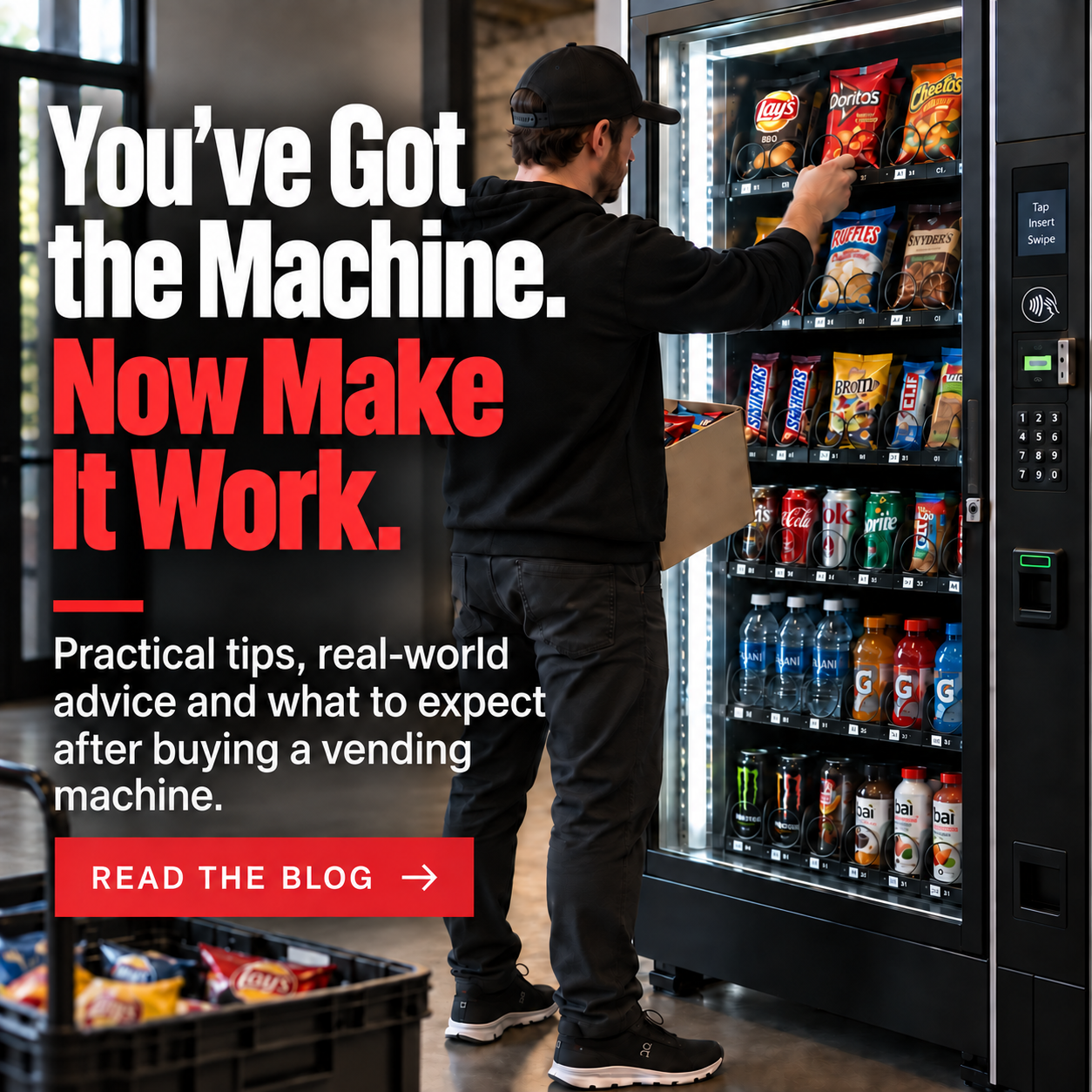
You researched machines, watched the videos, ran the numbers, found a vending machine you liked and finally bought it.
Now what?
This is the part a lot of “how to start a vending business” guides skim over. Buying the machine is relatively straightforward. Turning that machine into a reliable source of income takes a little more thought. You have to find—or properly evaluate—a location, decide what to sell, set prices, figure out payments, establish a restocking routine, maintain the equipment and eventually determine whether the location is performing well enough to keep.
The good news is that you do not need to have everything perfectly figured out before you begin. You do, however, want to approach those first few months like an operator instead of simply someone who owns a vending machine.
Here is where we would start.
First: Don't Buy Products Until You Understand the Location
The biggest mistake new operators make may be stocking the machine with what they think people will want.
A warehouse, high school, apartment complex, medical office and auto repair shop can all support vending, but they are not the same customer. A drink or snack that flies out of a machine at one location may sit untouched at another.
Before filling your machine, spend a little time learning who will actually be using it. How many people are regularly at the location? Are they employees who are there eight hours a day, customers who stay for 30 minutes, students between classes or residents who might visit the machine at night? Are there other food options nearby? What time of day is traffic highest?
Then ask the people who are there.
A five-minute conversation with employees, a property manager or the person responsible for the location can save you from buying cases of products nobody wants. Ask what drinks people typically buy, whether energy drinks are popular, whether they want healthier choices and if there are products they wish they could get without leaving the property.
Start with some proven staples, but leave room to experiment.
Think of Every Coil as Real Estate
This is something new operators rarely hear: every selection in a vending machine has a job.
If a product barely sells, it is not just sitting there. It is occupying space that could potentially hold something that sells several times faster.
That is why your first product mix should never become your permanent product mix simply because the machine is full.
Track sales. Watch which selections empty first. Notice which products are still sitting there during your next service visit. Give promising products enough time to establish a pattern, then replace chronic slow sellers.
Modern vending-management systems can make this much easier by showing operators sales by machine, location and product. Some systems can also track stock levels and alert operators when inventory is running low. That lets operators base product decisions on actual sales rather than guessing.
Your goal isn't to create the world's most interesting vending machine. Your goal is to give that particular location more of what it consistently buys.
Your Product Mix Should Change With the Location
Imagine putting the same snack-and-drink lineup in every machine you own.
It would certainly make shopping easier, but it probably would not maximize your sales.
At a warehouse or manufacturing facility, larger drinks, energy drinks, substantial snacks and quick meal options may outperform tiny snack portions. At a gym, sports complex or recreation center, water, electrolyte drinks and protein-focused options may deserve more space. An apartment property may perform differently at night and on weekends, with convenience products potentially making sense alongside traditional food and drinks.
Schools, offices, healthcare environments and seasonal locations each create their own buying patterns.
This gets even more important as you add machines. Sales reporting can show that a product that performs extremely well in one machine may move slowly somewhere else. Product mapping and machine-level sales data allow operators to identify those differences and adjust each machine accordingly.
Your route can still share plenty of inventory. Just don't force every location into an identical planogram.
Price for the Business You Actually Have
Another common startup mistake is setting prices based primarily on what products cost at the grocery store.
Your vending price has to cover considerably more than the item inside the coil.
You have product cost, payment-processing fees, fuel, vehicle expenses, sales tax where applicable, spoiled or damaged inventory, commissions or revenue sharing with locations, equipment costs, repairs and the time required to shop, stock and service the machine.
That doesn't mean you should simply charge as much as possible. Your prices still have to make sense for the location and your market. It does mean that a product with a 50-cent markup is not necessarily making you 50 cents.
Know your actual margins.
When supplier prices change, review your vending prices too. Leaving prices untouched for years while every cost around you rises is an easy way to stay busy while watching your profit disappear.
Cashless Payment Isn't an Afterthought
If your machine supports a card reader, decide how you want to handle cashless payments early.
Customers increasingly expect to be able to tap a card, phone or watch, and a cashless system can also give operators something almost as valuable as the payment itself: information.
Depending on the equipment and platform, operators can remotely view sales, identify low inventory, monitor machine status and see product performance without physically visiting every location.
For a new operator, that becomes incredibly helpful as the route grows.
Instead of driving to a machine because you think it might need stocked, you can increasingly service it according to actual demand.
Don't Confuse a Full Machine With a Healthy Machine
Walking away from a machine that is completely full feels good.
It does not automatically mean you stocked it correctly.
Overstocking slow products can create expiration problems and tie up money in inventory. Understocking your best sellers means customers repeatedly see empty selections and you lose sales that could have happened.
The better approach is to learn the service rhythm of each location.
A busy machine may need attention several times a week. Another may only need service every week or two. Some machines have dramatic differences between Monday-through-Friday demand and weekends. Others may change seasonally.
Inventory-management tools can help operators build product maps, track quantities and create more efficient restocking plans based on what each machine is actually selling.
You want enough product to meet demand without carrying unnecessary inventory everywhere you go.
Keep a Small Route Kit. You Will Thank Yourself.
A vending machine will eventually need something while you are standing in front of it.
It might be a jammed bill acceptor. A product may be hanging in the coil. A price may need changing. Something may need cleaned, tightened or reset.
Keep basic tools and supplies in your vehicle so every small issue does not become another trip.
Depending on your equipment, your kit might include cleaning supplies, a flashlight, basic hand tools, extra price labels, machine keys, small replacement parts you commonly use, zip ties and a notebook or digital checklist for recording problems.
You are not trying to turn yourself into a vending technician overnight. There is a very important line between routine operator maintenance and repairs that should be handled by someone experienced with the equipment.
The goal is simply to avoid wasting an hour because you forgot a screwdriver.
Your Machine Needs to Be Clean
This sounds obvious.
It gets overlooked surprisingly often.
Customers see the front of the machine before they see the products. Dirty glass, sticky buttons, dusty shelves, faded labels or an overflowing trash can beside the machine immediately affect how the entire location feels.
Cleaning should be part of every service visit.
Wipe down the glass and payment area. Remove dust and debris. Look for expired products. Straighten selections. Make sure product labels and prices are easy to understand. Test anything that appears questionable.
A vending machine is a tiny unattended retail store. Treat it like one.
Give Customers a Way to Reach You
Even an excellent machine will occasionally take a payment without dispensing correctly, experience a jam or develop another issue.
Put your contact information somewhere customers can easily find it.
A simple phone number, text number, QR code or email address gives customers a way to report problems instead of simply deciding never to use the machine again. It can also alert you to a problem long before your next scheduled service visit.
Vending-management providers specifically recommend providing customer contact information at each location so operators can learn about issues quickly.
Respond quickly when someone reaches out. A $2 refund handled well can preserve a customer who may spend hundreds of dollars at that machine over time.
Learn the Difference Between a Machine Problem and a Location Problem
This one can save operators a lot of frustration.
If sales are low, it does not automatically mean you chose the wrong products or bought the wrong machine.
Sometimes the location simply isn't strong enough.
Traffic matters, but so does placement inside the location. A vending machine hidden around a corner may dramatically underperform the exact same machine placed near a break room, lobby or natural gathering area. Visibility, accessibility and proximity to competing food options can all affect sales.
Before giving up on a location, consider whether the machine could be moved to a better spot, whether pricing is appropriate and whether the product mix matches the people using it.
If you have tested those things and sales still do not justify the time required to service the account, relocating the machine may be the best business decision.
A mediocre location does not become a great location because you keep filling it.
Pay Attention to the Route Before You Add More Machines
New operators naturally start thinking about machine number two, three and four.
Growth is exciting, but route density matters.
Five profitable machines scattered across a huge geographic area can become far less attractive after you calculate the hours and fuel required to service them. Several machines located relatively close together can create a much more efficient route.
As you evaluate new locations, don't just ask, “Will this machine sell?”
Ask, “Does this location fit the business I'm building?”
A slightly smaller account close to three existing stops may ultimately be more valuable than an isolated machine an hour away.
Keep Records Earlier Than You Think You Need Them
When you own one machine, you may think you'll remember everything.
You won't.
Record what you buy, what you pay, what you sell, your machine revenue, repair expenses, card-reader fees, commissions, mileage and other operating costs.
If you change products or prices, record that too.
Those records eventually answer the questions that matter: Which machines are truly profitable? Which products deliver the best margins? Which locations are growing? How often are machines requiring repairs? How much inventory are you carrying?
The sooner you establish those habits, the easier it is to understand the business when you grow.
Expect Your First Few Months to Be an Experiment
You do not need to know the perfect product lineup on Day One.
Your customers will teach you.
Put together a thoughtful initial selection, watch what happens, and adjust. If something sells out every time, give it more space. If something barely moves, replace it. If customers repeatedly ask for a particular product, test it.
Use your sales data instead of becoming emotionally attached to products.
The same principle applies to service schedules, pricing and even locations. Vending works best when operators continually refine the business based on what their machines are telling them.
One More Thing: Know Who You're Going to Call When the Machine Stops Working
This may be the part that many vending-business startup videos leave out.
Machines break.
Coin mechanisms fail. Bill validators stop accepting bills. Refrigeration systems develop problems. Motors, control boards, card readers and delivery systems can malfunction.
When the machine is not working, it is not generating revenue.
Before you are dealing with a machine full of drinks that isn't cooling or a payment system that suddenly stopped working, know where you can get service and parts.
If you're operating in greater Atlanta or North Georgia, Georgia's Vending Repair Center can help with vending machine repair, maintenance, parts, installation and delivery. We also sell professionally refurbished vending machines and can help newer operators understand what they are buying before they put a machine into service.
Bought the Machine? Now Build the Business.
Owning vending equipment is the first step. The operators who build sustainable routes learn their locations, listen to their customers, watch their numbers, keep their equipment working and make changes when the data tells them something isn't working. You do not need 50 machines to start thinking like an operator. Start with the machine you have. Learn everything you can from it. Then make the next one better.
Need help getting your vending machine ready for service? Georgia's Vending Repair Center provides vending machine repair, maintenance, parts, installation, delivery and refurbished machine sales throughout greater Atlanta and North Georgia. Contact GVRC today to get your machine—and your vending business—moving in the right direction.