
Seasonal Locations, Year-Round Income: How to Build a Vending Route That Stays Profitable All Year
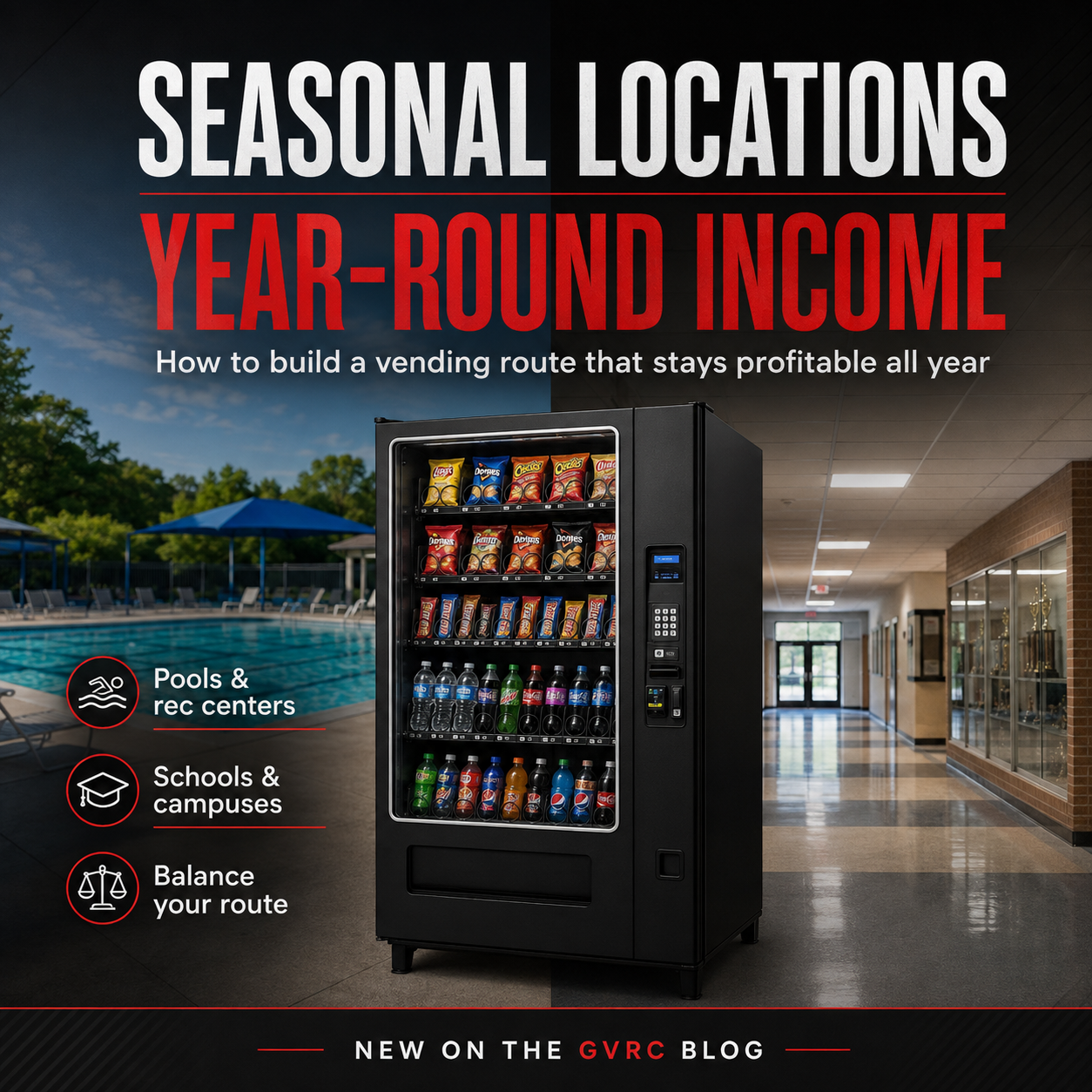
A busy community pool can be an incredible vending location in July. A school can be an incredible vending location in October. Neither one is necessarily going to produce the same revenue twelve months a year, and that doesn’t make either of them a bad location. It simply means vending operators need to build their businesses with seasonality in mind instead of expecting every machine to perform exactly the same way every month.
The real problem isn’t having seasonal vending locations. The problem is accidentally building an entire route made up of locations that get busy — and slow down — at exactly the same time. If you plan for those shifts from the beginning, some of your most seasonal machines can also become some of your most profitable, while the rest of the route provides the steady income that keeps the business healthy throughout the year.
Here’s how we’d approach it.
Start by Understanding the Role of Every Location
Take a look at every machine on your route and ask when that particular location is busiest. Most accounts will fall into one of three broad categories: year-round locations, spring and summer-heavy locations, or school-year and cool-weather locations.
Year-round accounts should form the foundation of the business. Manufacturing facilities, warehouses, hospitals, apartment communities, hotels, busy office environments and other workplaces with consistent occupancy may still experience monthly fluctuations, but their customer base doesn’t disappear for an entire season. These are the machines you want producing dependable revenue month after month and carrying as much of your basic operating overhead as possible.
Then you have locations that can become exceptionally strong during warmer weather. Pools, outdoor recreation centers, sports complexes, campgrounds, parks, marinas, tourist destinations and similar locations may produce significantly more revenue once temperatures rise and people spend more time outside. A machine in one of these locations might not look particularly impressive in February, but that same machine could be one of the highest producers on your route in June and July.
Schools, colleges, indoor athletic facilities and other locations tied to the academic calendar tend to work in the opposite direction. They may perform very well from late summer through spring and then fall dramatically when students leave for the summer. Rather than viewing that downtime as a problem with the location, look at what the machine contributes over the entire year and how its peak months fit with the rest of your route.
Once you look at your machines this way, you can start building a route where those different seasons work together instead of against you.
Don’t Build a Route Where Everything Slows Down at Once
Imagine an operator with 20 machines and 15 of them are in schools. On paper, that may look like a fairly established 20-machine business, but the operator is heavily dependent on one calendar. When school lets out, most of the route slows at the same time.
The same thing happens at the opposite end of the spectrum. If most of your machines are located at pools, parks, outdoor sports facilities and other warm-weather destinations, summer could be fantastic while January becomes painfully slow.
A healthier route intentionally mixes those different types of accounts. As a planning framework, you might aim for roughly 50 to 60 percent of your revenue-producing locations to be dependable year-round accounts, with the rest divided between locations that peak during different parts of the year. Those percentages don’t need to be exact. The point is to make sure one seasonal shift doesn’t affect nearly every machine you own.
When school traffic starts dropping in late May, pools and recreation facilities should be gaining momentum. When those summer locations begin slowing around Labor Day, students are returning to school. Meanwhile, your warehouse, apartment, manufacturing and other year-round machines continue producing throughout both seasons. You aren’t trying to eliminate seasonality. You’re using different types of locations to balance it.
Know the Monthly Income Your Business Needs
Before chasing every potentially high-volume account, figure out what your vending business actually needs to generate every month. Include product costs, fuel, card-processing and telemetry fees, insurance, equipment payments, commissions, repairs, storage or warehouse costs, labor and the income you personally need the business to provide.
Suppose you determine that your route needs to generate $8,000 in gross profit each month to comfortably cover expenses and provide the income you expect. Ideally, you don’t want to hit that number by making $14,000 during a huge summer month and hoping it carries you through a $2,000 winter month. The stronger model is to build enough dependable, year-round revenue to cover as much of that $8,000 base as possible, then allow seasonal locations to create additional profit during their strongest months.
That changes how you evaluate new opportunities. A high-volume seasonal location can still be extremely attractive, but you’re no longer depending on it to hold up the entire business during months when its traffic naturally disappears.
Build a 12-Month Revenue Map
One of the simplest planning tools for a vending operator is a spreadsheet with January through December across the top and each location listed down the side. Instead of trying to predict exact sales for every month, simply classify the expected demand at each location as high, normal, low or closed.
A school might show normal traffic from January through April, begin slowing in May, become very low or closed during June and July, increase again in August and peak in September and October. A neighborhood pool might show almost the opposite pattern. A manufacturing facility may stay relatively consistent across all twelve months.
Put those locations together and you’ll quickly see whether your route is balanced or whether there are months when too many machines are expected to slow at the same time. You can also use the same calendar to guide your prospecting. If February consistently looks weak, your next goal shouldn’t simply be “find another good vending location.” It should be “find a good vending location that performs particularly well during the months when my current route is weakest.”
At that point you’re no longer looking at a collection of machines. You’re managing a portfolio of revenue-producing locations.
Judge Seasonal Machines by Their Annual Performance
Seasonal accounts can look deceptively weak if you evaluate them during their worst month. Suppose one machine generates $800 per month for nine months of the year and almost nothing during the remaining three. Another machine consistently generates $450 every month.
The first machine produces approximately $7,200 annually, while the second produces around $5,400. Looking at the seasonal machine during one of its slow months could make it seem like the weaker account when its annual contribution is considerably higher.
Revenue alone isn’t enough, either. Look at product costs, commissions, drive time, service frequency, maintenance needs and the amount of labor the location requires. A machine that produces heavily during its peak season and requires almost no attention while the location is closed may be an excellent asset. Another machine might produce similar annual sales but require a long drive and constant service, making it far less profitable than it appears.
The goal is to understand what every machine contributes to the business over the entire year.
Let Your Service Schedule Change With Demand
If your customers don’t behave the same way every month, your route schedule shouldn’t either. A pool machine might need significantly more attention during a 95-degree week in July than it does in September. A school machine may suddenly require heavier service as soon as students return in August, while another machine nearby stays relatively unchanged.
Modern telemetry can make this much easier because operators can use real sales and inventory data to determine which machines actually need service instead of physically visiting each machine just to check it. Even without telemetry, you can use historical sales and established par levels to adjust your route as demand changes.
The important thing is to avoid servicing every machine on the exact same schedule simply because that’s how the route has always been run. During a location’s peak season, increase service frequency as necessary so you aren’t losing sales to empty selections. During slower periods, reduce unnecessary visits and put that time toward accounts that are producing more.
That flexibility can improve both route efficiency and profitability.
Change Your Product Mix With the Season Too
The location isn’t the only thing that changes with the seasons. What people want to buy changes too.
A machine beside a swimming pool in July probably shouldn’t have the same exact product mix as a warehouse machine in January. Water, sports drinks, electrolyte beverages and lighter snacks may deserve more space in warm-weather locations, while other environments may perform better with traditional snacks, breakfast items, energy products or more substantial food.
Instead of guessing, use the sales data from each machine to guide those decisions. Look for products that consistently sell out and products that sit untouched. Give more space to the strongest sellers and rotate out items that aren’t earning their place in the machine.
This is especially valuable at seasonal locations because you have a relatively short window to maximize sales. If a pool is busiest for three months, you don’t want to spend half the summer slowly figuring out what customers want. Use what you learned the previous season to start the next one with a stronger product mix from day one.
Use Seasonal Revenue to Build the Stable Part of Your Route
This is where seasonality can become a growth strategy instead of something operators simply tolerate.
Suppose your pool, park and recreation machines generate a significant revenue surge from May through August. Rather than allowing your personal or business spending to grow around that temporary increase, intentionally earmark some of that additional profit for expansion.
Use the strong summer to purchase the next refurbished machine, then place that machine in a warehouse, apartment community, manufacturing facility or another year-round location. When the following summer arrives and those seasonal machines surge again, repeat the process.
Over time, your seasonal locations are helping finance the part of the route that produces consistent revenue throughout the year. Instead of needing more and more summer-heavy accounts to grow, you’re using the profitability of those machines to strengthen the foundation of the business.
That creates a much healthier growth cycle.
Prospect for the Season You Need Before It Arrives
A predictable slow season shouldn’t sneak up on you. If most of your machines are in schools and your route falls off every June, you shouldn’t wait until the last day of school to begin looking for summer business.
Start months ahead.
During the winter, pursue pools, recreation facilities, campgrounds, outdoor sports complexes and other accounts that will become stronger during spring and summer. As summer approaches, begin pursuing schools, colleges, indoor recreation and locations that become busier in late summer and fall. Throughout the year, continue looking for strong year-round accounts such as warehouses, manufacturing facilities, apartments and workplaces that can strengthen the foundation of the route.
This turns prospecting into something much more strategic. Instead of taking whatever location happens to become available, you can deliberately look for accounts that fill specific gaps in your calendar.
If your weakest quarter is January through March, that should influence the kinds of accounts you pursue next. If July is already your strongest month by far, another location that only performs in summer may be less valuable to the overall business than an account that strengthens February.
Use the Slow Season to Work on the Business
A machine slowing down doesn’t mean the operator has to slow down with it. In fact, quieter months can be some of the best times to improve the business.
Use those periods for preventive maintenance, deep cleaning, replacing worn components, reviewing card-reader and telemetry performance, adjusting pricing, analyzing product sales and reorganizing inventory. It’s also a great time to meet with location managers, ask about upcoming changes at existing accounts and actively prospect for new locations.
If you know a group of machines will be quiet for several weeks or months, you can also use that time to prepare equipment for the next expansion. Purchase or refurbish machines, line up new placements and improve route density so you’re ready to grow when traffic begins increasing again.
Peak season is when you maximize the revenue the route can produce. Slower periods are when you make the business better so the next peak season is even stronger.
Pay Attention to Route Density
There’s one more factor that can quickly turn an otherwise decent seasonal location into a bad business decision: distance.
A pool producing $300 a month that sits five minutes away from four other machines may fit very nicely into an existing route. The exact same pool sitting 45 minutes away by itself may be far less attractive once you account for fuel, travel time, loading and service.
That’s why every new location should be evaluated as part of the route rather than as an isolated machine. Ask whether the account strengthens an area you already service or creates an entirely new trip.
Sometimes the best next vending location isn’t the one with the highest projected sales. It’s the good account located three minutes away from machines you’re already servicing.
A Simple Way to Build a Route From Scratch
For a newer vending operator, the easiest way to avoid becoming overly dependent on one season is to think about balance from the first few placements.
With the first several machines, prioritize dependable year-round accounts that can begin establishing a consistent revenue base. Once that foundation is forming, a strong seasonal opportunity can be a great addition. After adding it, return your attention to year-round accounts before adding another seasonal machine.
As the route grows, deliberately look for locations whose strongest months offset the seasonal accounts you already have. If you land an excellent pool location, you don't necessarily need another pool next. A school, warehouse, apartment community or indoor facility may do more to strengthen the overall business.
Once you reach ten machines, review the entire calendar and identify where projected revenue drops. Do the same thing again at 20 machines, 30 machines and beyond. Your next prospecting target should increasingly be determined by what the entire business needs rather than simply whether an individual location sounds good.
That changes the question from “Is this a good vending location?” to “Is this a good vending location for the route I’m building?”
Seasonal Doesn’t Have to Mean Unpredictable
Pools close. Schools have summer break. Sports have seasons. Tourism rises and falls. None of those things are surprises, which means operators can plan around them.
A strong vending business doesn’t need every machine to generate identical revenue every month. It needs a mix of machines whose combined performance creates dependable income across the year.
Build a solid foundation of year-round accounts. Add profitable seasonal locations where they make sense. Look for locations with opposite peak seasons. Change your service schedule and product mix as customer demand changes. Use peak-season profits to fund additional year-round machines, and begin prospecting for your next seasonal need before that season arrives.
When you approach route growth this way, seasonal locations stop being a weakness you have to work around. They become another tool you can intentionally use to build a larger, stronger and more consistent vending business.
At Georgia’s Vending Repair Center, we work with both new and experienced vending operators who are building and expanding routes throughout the greater Atlanta and North Georgia area. If you’re adding a new location, replacing equipment or trying to determine which type of machine is right for a particular account, give us a call. Our refurbished inventory changes regularly, and we’re happy to help you find equipment that fits your location, product mix and business goals.