
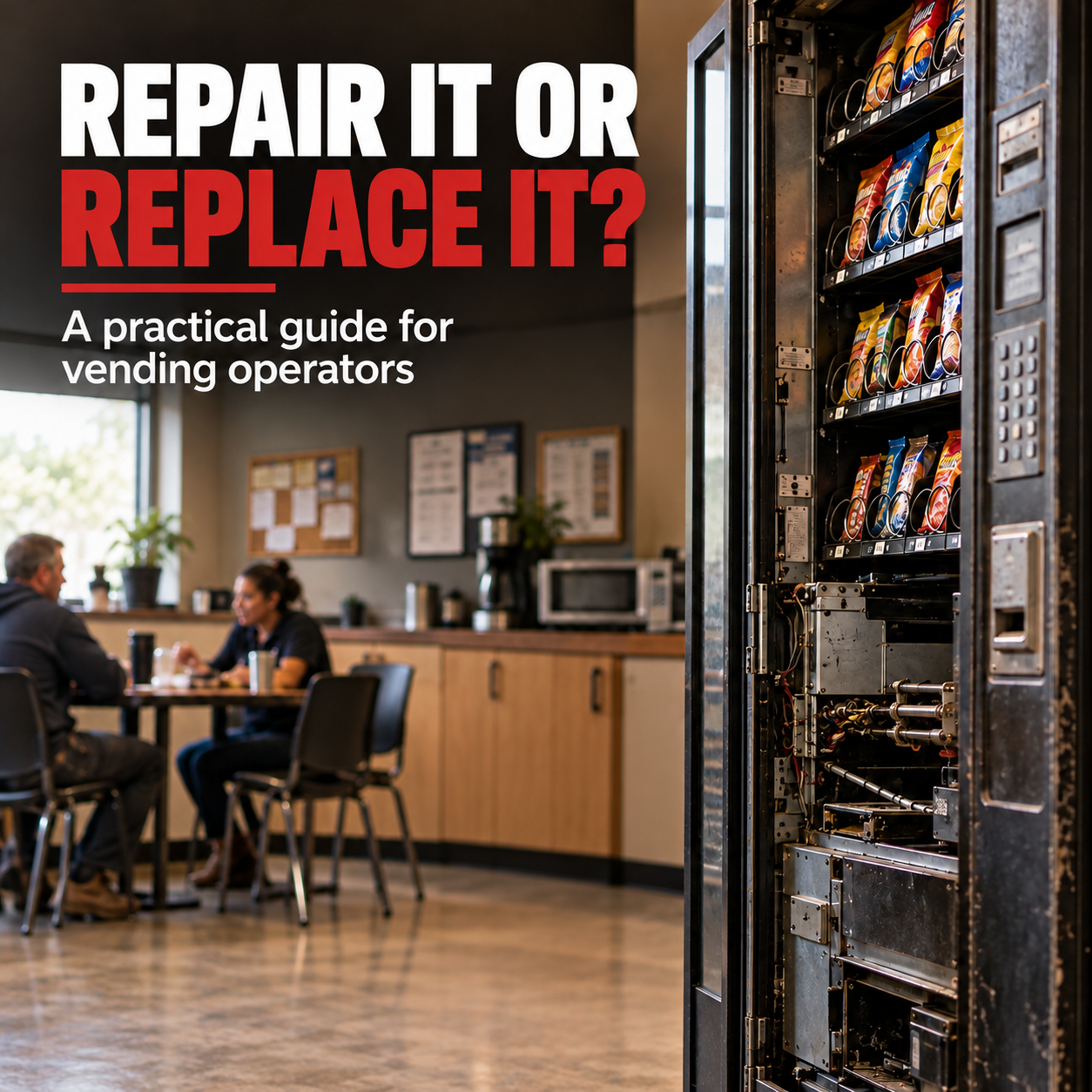
Every vending operator has a machine that seems to pick the worst possible moment to act up. A payment reader goes offline before a busy shift. A refrigeration issue puts drinks at risk. A spiral stops turning, and the product customers came for stays stuck behind the glass.
The first question is usually, “How much will it cost to fix?” A better question is, “Will fixing it put this machine back on a dependable path to earning?”
A repair quote is only one part of the decision. You also need to consider how often the machine has needed service, how long it may be out of order, whether parts are available, and what sales you may lose while it sits. The right answer might be a repair, a replacement, or a conversation with the location about whether the machine still fits the account.
Start with the machine’s repair history
Before approving a major repair, gather the machine’s recent service records. Write down each problem, its date, the repair performed, the cost, and how long the machine was unavailable. If you don’t have a formal service log, pull the information from invoices, texts, notes, and payment system reports.
Look for patterns. A single repair on an otherwise dependable machine is different from repeated failures in the same system. Several unrelated problems close together may also suggest that the machine is nearing the point where more repairs are likely.
Ask the technician what the proposed repair is expected to address. Does it fix one isolated component, or is it part of a larger issue? Are replacement parts readily available? Is there a risk that another aging component could fail soon? A clear explanation helps you compare the repair with the machine’s actual condition.
Estimate the cost of downtime
A machine that cannot sell is still costing you time and may be costing you revenue. To estimate the impact, start with the machine’s average daily sales. If it averages $45 a day and is expected to be down for four days, that is roughly $180 in sales that may be delayed or lost.
That is a sales estimate, not lost profit. The products you would have sold also have a cost, and the machine may make up some sales after it returns to service. Still, estimating the sales at risk gives you a more useful picture than looking at the repair invoice alone.
Factor in the time you spend managing the problem, traveling to the location, arranging service, and updating the site contact. Those hours matter, especially when a machine has repeated issues or is far from the rest of your route.
Compare repair with replacement
Use a simple comparison:
Repair cost + likely downtime costs + expected follow-up repairs
versus
Replacement cost + delivery or installation + setup time
Then ask how long you expect the machine to operate reliably after the repair. A $400 repair may be a sound decision if it addresses a clear, isolated failure and the machine is otherwise dependable. The same repair may be hard to justify if it is one of several recent expenses and the machine continues to lose sales.
Replacement does not automatically mean buying the newest or most expensive model. The right machine depends on the location, the products being sold, the payment setup, and whether the equipment can be serviced efficiently. If you are considering replacement, compare the full cost of getting the new machine earning at the location—not just the purchase price.
The SBA’s break-even guidance is useful here: include fixed and variable costs, then compare the expected return with the cost of the decision. Its basic formula is fixed costs divided by the contribution margin per unit, but a vending operator can use the same thinking to compare a repair investment with the sales the machine is realistically able to support.
Don’t forget the location
A machine can be mechanically repairable and still be the wrong fit for the account. If the location has changed its hours, staffing, or customer traffic, restoring the machine may not restore the sales you expected.
Before making a large investment, check in with the site contact. Confirm that the machine is still useful, ask whether customers have reported problems, and discuss access for service. A quick conversation can reveal whether the account is healthy enough to justify the repair.
Make a decision you can review later
Write down the repair cost, estimated downtime, machine’s recent sales, and your decision. If you repair it, set a date to review its performance. If sales and reliability return to normal, you have useful evidence for the next service decision. If problems continue, you will know when it is time to consider a different plan.
A vending machine does not need to be perfect to be profitable. It does need to be dependable enough to serve the location without consuming all the time and money it is supposed to earn.